
Why AMS runs competitions
Why AMS brings people together around demanding problems, and what competitors and partners can learn from the work.
A good problem gives people something concrete to work on together. You have to decide where to begin, test your assumptions, and work through what happens when your first approach falls short. Those decisions are part of what makes mathematics and engineering worth pursuing.
AMS (Algorithms & Mathematics Society) runs national competitions in quantitative reasoning and systems engineering. We want to give people a place to take that work seriously, test themselves, and meet others who share their interest.
A reason to put your skills to work
It is one thing to understand a technique while studying it. Applying it to an unfamiliar problem asks more of you: choosing an approach, checking whether it fits, and deciding how to use the time available.
A competition gives that effort a structure. There is a defined task, a time limit, and a scoring system. You can see how your work performs under those conditions and use the experience to decide what to practise next.
The subject matters. Derive asks competitors to reason about probability, markets, and mathematics. Ascent focuses on C++, optimization, and systems performance. They offer different ways to put technical interests into practice.
What Derive brought together
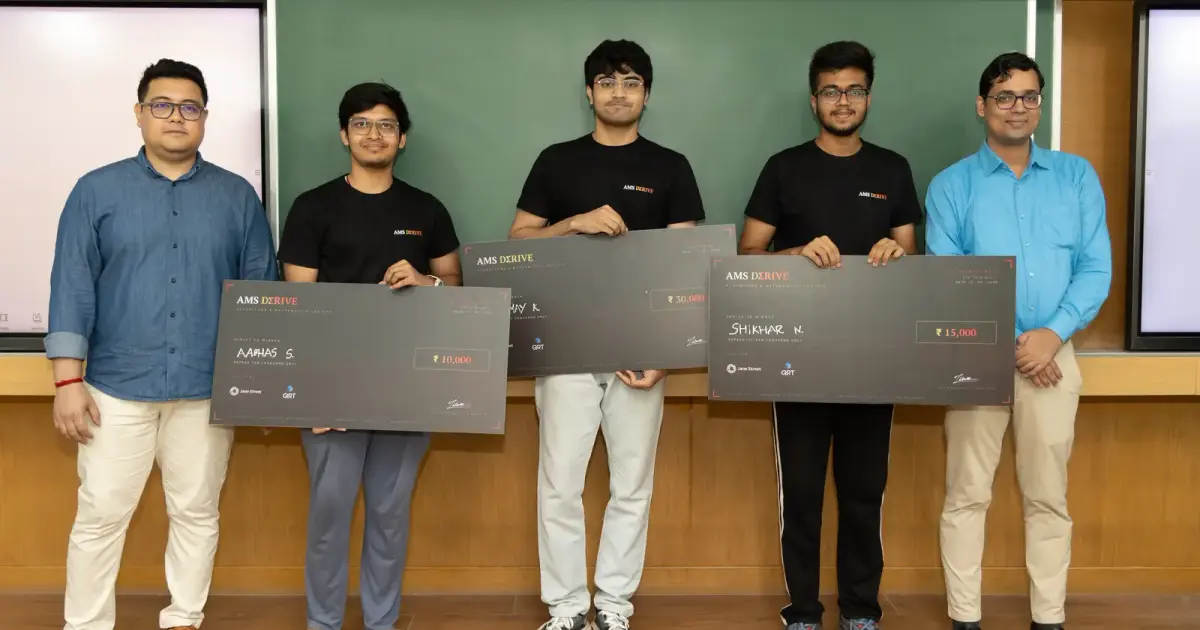
Derive '26 began with 2,500+ participants. The top 150 advanced to Round 2, 50 qualified for the finals, and 33 competed in person at IIT Bombay in July 2026.
Those rounds gave participants a shared challenge. The finals also made room for conversations with one another and with people from partner firms. The problems provided a starting point: something people had worked on, could discuss, and could learn from together.
Jane Street was the Apex Partner of Derive '26, and QRT was the Convergence Partner for the finals. The edition overview records the format and partners; the gallery shows the contest and the conversations around it.
What the result tells us
A contest result is evidence of performance on a particular set of problems. The tasks and conditions determine what that evidence means. A strong result can be a useful starting point for a technical conversation, alongside a person's projects, experience, and explanation of their work.
For recruiting teams, the useful question is how closely the contest's demands relate to the skills they need. Quantitative reasoning and performance engineering call for different kinds of work. A partnership should begin with that fit, then define how the team will take part.
What we want to keep building
Our aim is to bring people back to challenging work and to one another. Thoughtful problems, clear rules, and opportunities to exchange ideas are the parts of that experience we want to develop.
If you want to compete, explore Derive or Ascent and see which problems interest you. If your team would like to support a competition, start with the skills and audience you want to engage.