
Blog
What AMS actually is
What AMS actually is
AMS (Algorithms & Mathematics Society) is an Indian organization that runs national contests in quantitative finance and competitive programming, and builds Access, the platform that turns contest performance into verified hiring signal. It is not affiliated with the American Mathematical Society, despite sharing three letters.
Where it started
AMS began as a question I could not shake: India produces world-class competitive programmers and quants, so why is there no institution that measures them on their own terms?
Tilak, Founder
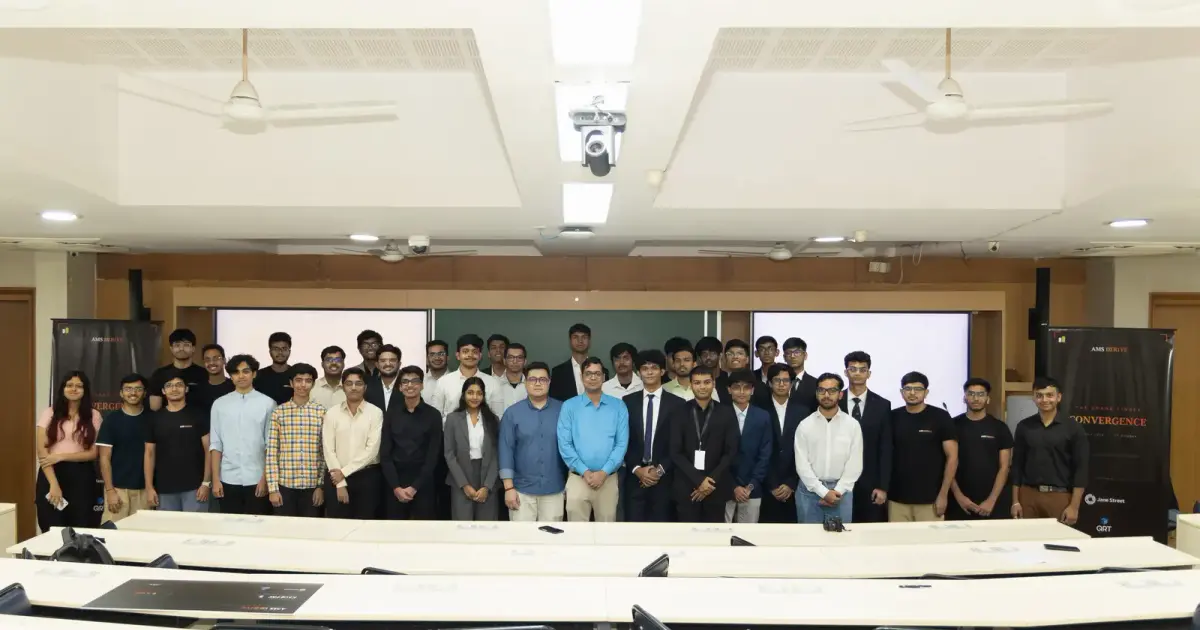
Last July, that question got an answer in a lecture hall at IIT Bombay: a national field narrowed to one stage, judged in person by the firms that hire this talent. That was Derive '26.
Derive: the quant contest
Derive is timed reasoning under pressure: probability, markets, and mathematical thinking, scored the same way for everyone in the room. The '26 edition ran in three stages:
- Round 1, open to everyone: 2,500+ participants entered.
- Round 2, the cut: the top 150 advanced.
- Finals, offline at IIT Bombay: 50 qualified, and 33 competed on stage in July 2026.
Jane Street was the Apex Partner of Derive '26. QRT backed the Convergence finals, where those 33 finalists competed in person.
Ascent: the systems contest
Ascent is Derive's winter sibling: same road, different discipline. It measures modern C++ under tight memory and time constraints, algorithmic optimization, and performance engineering, the code that runs the systems behind the markets Derive reasons about. It follows the same template Derive set: online rounds to earn a seat, then finals judged in person with sponsor firms in the room. Registration for the first edition isn't open yet.
Access: the platform
Access takes the same idea and rents it to firms. It is a native desktop client for Windows and Linux, not a browser tab: system shortcuts, app switching, and screen recording are locked at the OS level for the length of a session. Before anyone sits an exam, seven readiness checks (camera, microphone, network, restricted apps, keyboard lockdown, platform, and VM integrity) all have to read clear, and outbound network traffic stays allowlisted to the contest API for the duration.
The part that matters most to a firm: every Access assessment is scored against the population that competes in Derive and Ascent. When a candidate clears your bar on Access, you know exactly where that bar sits, against 2,500+ of India's competitive best, not a generic test bank.
The talent pool behind it
AMS has conducted two competitions to date, drawing a talent pool of 5,000+ students from 30+ institutions across India. That pool is the reservoir; Derive and Ascent are how it gets ranked, and Access is how a firm gets to use the ranking.
The team
AMS is run by a small team of competitors: the people who set the problems, run the halls, and build the platform. Tilak founded it; the rest of the team covers engineering, design, operations, and outreach. Built by competitors, for competitors, which is also the only pitch AMS has ever needed to make to a sponsor.
Where to go from here
See the contest itself.
Reading about it is one thing. Derive '26 drew 2,500+ participants; the next edition is where you'd be one of them.